 blog
Best Commercial Roofing Waterproofing Services in 2026
Last Updated: October 23, 2026
Quick Summary
The best commercial roofing waterproofing services diagnose before they quote, using moisture readings, core samples and seam checks to price your actual roof instead of guessing. Judge providers on licensing, documented project experience, a written inspection process, readable warranty terms and verifiable reviews.
- Ask every roofer to walk you through what they do before they quote.
- Leak detection traces water to its entry point using moisture readings and water testing.
- Repair suits localized leaks; replacement suits saturated insulation or failing seams.
- Coating cost depends on size, prep, coating type, mil thickness and warranty tier.
- Read warranty exclusions first, including ponding, foot traffic and third-party rooftop work.
Table of Contents
- What the Best Commercial Roofing Waterproofing Services Get Right
- Selection Criteria: How to Judge a Commercial Roofer
- Commercial Roof Leak Detection: Finding the Source Before You Pay for Repairs
- Commercial Roof Leak Repair vs. Replacement: What Actually Makes Sense
- Commercial Roof Coating Cost: What Drives the Number and What It Returns
- Your Commercial Roof Inspection Checklist for Every Season
- Waterproofing Systems Side by Side: TPO, PVC, Coatings, and Modified Bitumen
- Warranty Terms and Exclusions: What Commercial Roofing Waterproofing Contracts Really Cover
- Conclusion
- Frequently Asked Questions
What the Best Commercial Roofing Waterproofing Services Get Right
The best commercial roofing waterproofing services share one habit: they diagnose before they quote.
Waterproofing is not a product you buy off a shelf. It is a roof system decision: the membrane, the substrate, the drainage, the flashings and the seams all have to work together.
Here is the uncomfortable truth most contractor landing pages skip: the cheapest quote usually reflects the least investigation.
Below, we'll show you exactly how to judge a roofer, how leak detection actually works, and where repair ends and replacement begins.
Selection Criteria: How to Judge a Commercial Roofer
Judge a commercial roofer on five things: licensing and insurance, documented project experience on your roof type, a written inspection process, warranty terms you can read, and verifiable customer reviews. Everything else is marketing.
Licensing and insurance come first because a bonded and insured contractor protects your building and your budget if something goes wrong on the roof. Ask for the certificate, not a verbal assurance.
Project experience matters more than years in business. A crew that has waterproofed flat roofs and TPO systems on buildings like yours will spot the details a generalist misses.
A practical checklist for vetting any provider:
- Current license number and certificate of insurance on file
- Photos or project videos from comparable commercial buildings
- A written scope that names materials and prep steps
- Warranty document with exclusions spelled out
- Named point of contact for the project
- Service area that actually covers your property
The thing nobody tells you about comparing quotes is that a low bid and a high bid often describe different amounts of work. One includes preparation and flashing detail. The other assumes the surface is fine. That gap is where leaks start.
Commercial Roof Leak Detection: Finding the Source Before You Pay for Repairs
Commercial roof leak detection is the process of tracing water back to its entry point rather than patching where the stain appears. Water travels along decking, insulation and framing, so the wet ceiling tile is rarely sitting under the hole.
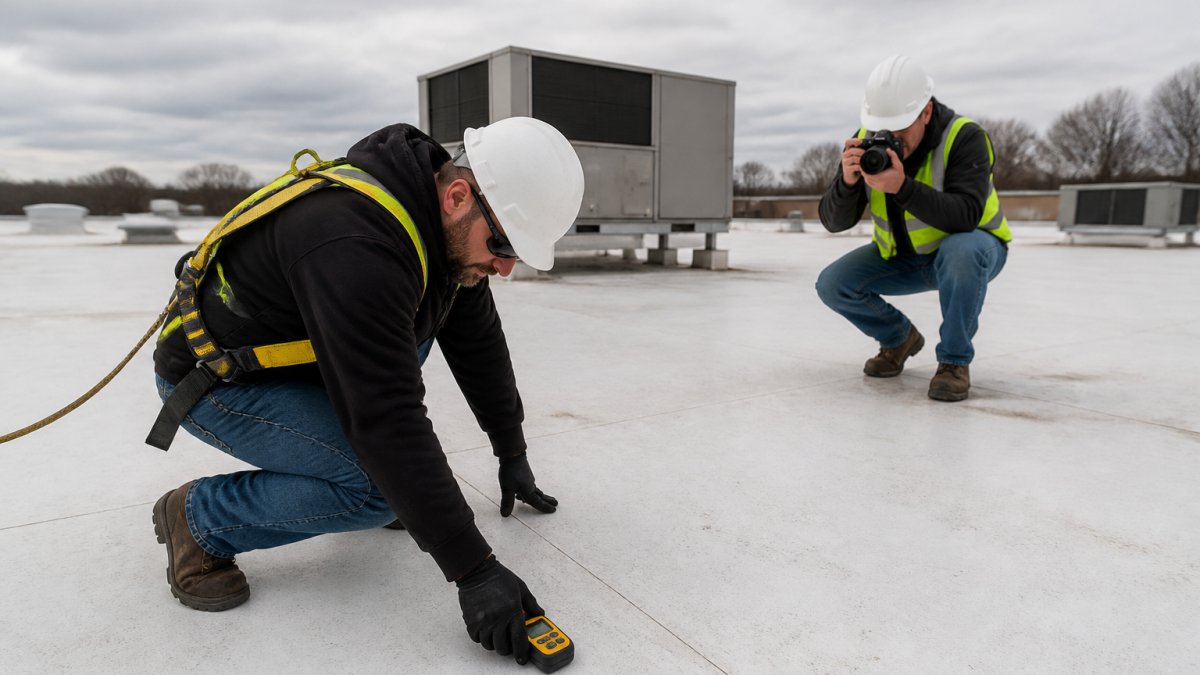
That is why leak identification deserves real time. A common mistake is paying for a repair at the visible stain while the actual breach sits several metres away at a curb, penetration or seam. The patch holds for a season, then the leak returns somewhere new.
Professional detection typically combines:
- Visual survey of seams, flashings, drains and penetrations
- Moisture readings across the membrane and insulation
- Water testing on suspect areas to confirm the path
- Photo documentation so you can see what the roofer sees
Commercial Roof Leak Repair vs. Replacement: What Actually Makes Sense
Repair makes sense when the leak is localized, the membrane is otherwise sound, and moisture has not spread into the insulation.
The decision comes down to roof condition, not roof age alone. A well-maintained flat roof can serve well past a typical replacement window, while a neglected one can fail early.
Where repair wins: isolated punctures, failed sealant at a curb, a single compromised flashing.
For buildings in between, roof restoration with a protective coating can extend service life and defer replacement.
Commercial Roof Coating Cost: What Drives the Number and What It Returns
Commercial roof coating cost depends on roof size, surface condition, coating type, prep work and the number of coats specified.
The cost drivers, in the order they usually move the number:
- Square footage and roof complexity. Penetrations, curbs, parapets, drains and HVAC units add labor and detail work. A simple, open flat roof prices very differently from a cluttered one of the same size.
- Preparation. Cleaning, pressure washing, seam repair, blister cutting, fastener replacement and priming are frequently the largest variable. Skipping prep is the most common way a low bid gets low.
- Coating system and mil thickness. A single-coat acrylic wash is not the same product as a multi-coat silicone or polyurethane system. Thickness is specified in mils, and more material costs more.
- Access and safety. Roof height, staging, fall-protection requirements and occupied-building scheduling all carry labor cost.
- Warranty tier. Longer material and workmanship coverage typically requires a specified system build-up and sometimes a maintenance agreement.
How to read a per-square quote. Commercial roofing is priced by the square (100 square feet).
What it returns. A reflective roof restoration system can lower heat load and improve energy efficiency, and it protects the existing membrane from weather and UV.
We recommend asking for the scope in writing: prep steps, product, thickness, price per square, and warranty. That document is what you compare across quotes, and it is the difference between a budget you can defend and a number you have to take on faith.
Your Commercial Roof Inspection Checklist for Every Season
A commercial roof inspection checklist should cover drainage, membrane condition, seams, flashings, penetrations and rooftop equipment. Run it seasonally, and always after severe weather.
Seasonal inspection checklist:
- Clear drains, scuppers and gutters of debris
- Check membrane for blisters, splits and punctures
- Inspect seams and flashings at walls and curbs
- Examine penetrations, vents and HVAC curbs
- Look for ponding water and poor drainage
- Check for interior stains after heavy rain
- Photograph and log every finding with a date
Proactive roof maintenance is cheaper than emergency repair, and it gives you a documented history of roof condition. That record helps when you plan budgets or evaluate whether a roof is trending toward replacement.
If your team lacks the training or access to do this safely, a scheduled roof survey from a commercial roofer is the practical alternative.
Waterproofing Systems Side by Side: TPO, PVC, Coatings, and Modified Bitumen
No single waterproofing system wins everywhere. The right choice depends on the existing roof, the substrate, drainage, how long you plan to own the building, and how much disruption the building can tolerate.
| System | Best For | Strengths | Watch-Outs |
|---|---|---|---|
| TPO membrane | Flat roofs, new construction and re-roofs | Heat-welded seams, reflective surface, moderate cost | Seam quality depends on installer skill; not a coating over an existing roof |
| PVC membrane | Flat roofs with chemical or grease exposure | Durable, chemical resistance, heat-welded seams | Higher material cost; plasticizers can migrate over time |
| Modified bitumen | Low-slope roofs, especially where torch or self-adhered layers suit the detail | Proven, layered protection, good at heavy foot traffic | Heavier, less reflective, more seams to maintain |
| Liquid-applied membrane | Complex details, flashings, transitions, repairs | Seamless cure, conforms to irregular shapes | Requires careful surface prep and cure windows |
| Silicone coating | Restoring sound single-ply and metal roofs | Highly reflective, UV-stable, ponding-water tolerance | Can be slippery when wet; not for foot-traffic areas without a walkway |
| Acrylic coating | Budget restoration of sound roofs in moderate climates | Reflective, lower material cost, easy application | Less durable in ponding water and freeze-thaw cycles |
| Polyurethane coating | High-traffic or harsh-exposure restorations | Tough, abrasion-resistant, good adhesion | Higher cost; moisture-sensitive during application |
How to read the trade-offs. Sheet membranes (TPO, PVC, modified bitumen) are installed as new roof surfaces and depend heavily on seam and flashing workmanship.
Matching system to building. A structurally sound but aging flat roof is often a candidate for reflective restoration with silicone, acrylic or polyurethane.
The right roof type depends on your building, budget and how long you plan to own it. A waterproof membrane is only as good as its installation and its detailing at edges and penetrations, so ask every bidder to name the system, the prep steps and the warranty that goes with it.
Warranty Terms and Exclusions: What Commercial Roofing Waterproofing Contracts Really Cover
Warranty terms and exclusions decide what a commercial roofing waterproofing contract actually pays for. Read the exclusions first, because that is where most disputes begin.
What to check before signing:
- Labor and material coverage and how long each lasts
- Exclusions for ponding, foot traffic, other trades, or storm damage
- Maintenance requirements the warranty depends on
- Transferability if you sell the building
- Who performs covered repairs and response times
A warranty that requires scheduled maintenance is normal. A warranty that voids on any third-party rooftop work is worth knowing about before your HVAC contractor walks up there.
What most guides miss is that warranty value tracks the quality of the installation. A strong warranty on a rushed job is a document, not protection.
Conclusion
The hardest part of buying commercial roofing waterproofing services is that every provider claims to be thorough, and the quotes rarely make the differences visible.
That is where GM Systems Commercial Roofing comes in. Founded by Greg Stierwalt, we focus on detailed roof analysis, targeted repair for active leaks, and energy-efficient reflective roof restoration that extends the life of existing roofs.
Get a free roof analysis from GM Systems Commercial Roofing and find out what your roof actually needs before you spend on a replacement.
Frequently Asked Questions
What is the best waterproofing for a commercial roof?
There is no single best system. TPO and PVC membranes suit new construction and full replacement on flat roofs, while reflective roof coatings work well for restoring an existing sound membrane at lower cost. The right choice depends on your roof type, its current condition, and whether the deck and insulation are dry. A proper commercial roof inspection should come first, because applying any waterproofing system over trapped moisture or a failing substrate shortens its life and can void the warranty.
How do commercial roofing contractors find roof leaks?
Commercial roof leak detection combines visual inspection with tools: moisture meters, infrared scans, and water testing. Because water travels along decking and insulation far from the entry point, the visible stain inside is rarely above the actual hole. A contractor traces the path back to seams, penetrations, drains, and flashing. Ask any provider to document the source with photos before quoting commercial roof leak repair, so you are paying to fix the cause rather than to patch a symptom.
Is it better to patch a commercial roof or apply a roof coating?
A patch is a targeted fix for one isolated defect on an otherwise sound roof. A reflective roof coating covers the whole surface and addresses widespread aging, seam wear, and small fractures at once. If your roof has several problem areas or is nearing the end of its service life, coating or restoration usually costs less than replacement and adds years of protection. If there is one clean puncture and the membrane is healthy, a proper commercial roof leak repair is the cheaper call. Get a roof analysis before deciding.
How much does commercial roof waterproofing cost?
Commercial roof coating cost and waterproofing pricing depend on roof size, system type, surface preparation, and the number of repairs needed before coating. Preparation is often the largest variable, because a coating will not bond to a wet or dirty surface. Rather than quote a figure that will not hold, a reputable contractor inspects the roof and provides a written scope. Request a free estimate with line items for prep, material, and labor so you can compare quotes on equal terms.